
Senate Bill 1968 went into effect Jan. 1. The legislation, filed by Republican sponsors last March and passed in June, directly affects licensing and regulations for Realtors in the state.
The bill amends the Texas Real Estate License Act, modernizing real estate agency law and clarifying the broker-buyer relationship, and adds new continuing education requirements for brokers.
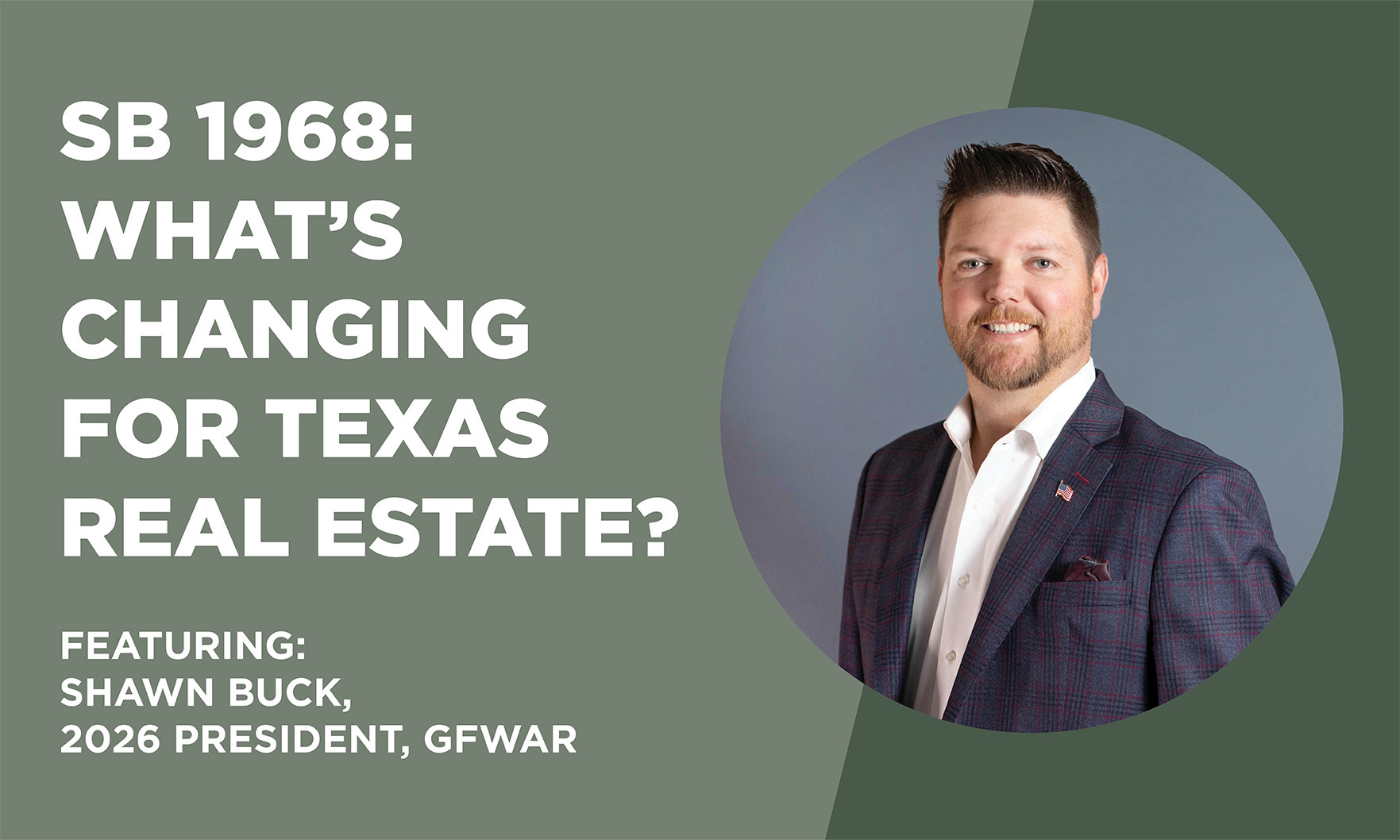
We spoke with Shawn Buck, 2026 president of the Greater Fort Worth Association of REALTORS®, who explained what Texas Realtors need to know about the updated legislation.
What’s changing
The biggest day-to-day change: Buyers must officially sign a written agreement before touring a home. While that’s been common practice for a while now, with many states adopting similar policies after the National Association of REALTORS® settlement in 2024, SB 1968 updates specific information that must be included in disclosure forms, including:
-
- Services to be provided
- Exclusivity
- Termination date
- Compensation rate and negotiability
Most agreements are non-exclusive, two-week contracts.
The bill also eliminates subagency, the practice where a listing agent represents an otherwise unrepresented buyer. That means we’ll no longer see transactions where one agent represents both the buyer and seller — unless it’s disclosed specifically through an intermediary, said Buck.
“All parties will know clearly before you head into that relationship,” he explained. “The key is for all parties to know exactly what they’re getting into.”
What clients need to know
Clients should have a more transparent view of their real estate transactions moving forward. Prior to seeing a home, they’ll hopefully have an understanding of everything the broker-buyer relationship entails, including potential commissions.
“Transparency is key,” said Buck.
Prospective buyers will have the option to attend showings without agent representation (in other words, without signing a disclosure) under certain circumstances — for example, if a seller’s agent lets them into a home.
However, under SB 1968, that listing agent wouldn’t be able to represent the buyer. Instead, they’d have to refer them to a colleague.
Continuing education
To become a real estate broker — i.e., own a brokerage, serve as a manager, etc. — Texas agents still must complete a certain number of continuing education courses. However, SB 1968 stipulates that real estate transactions now count towards those continuing education credits.
Up to 300 of the required 630 continuing education credit hours can be substituted. Other changes include limiting the bachelor’s degree credit to 300 hours (down from 630) and doubling the total amount of required experience to 720 hours.
One course broker applicants can’t skip, though, is the new Broker Responsibility Course. As of Jan. 1, the course is required for all new real estate agents applying to be brokers, plus those renewing licenses. There are both six-hour and 30-hour options, but Buck recommends taking both.
“Every transaction is different,” Buck said. “Understanding the liability and the risks that the broker holds responsibility for in representing clients is something every agent should go through as they progress in their career.”